In Partnership with Finanslicenser

AML Training & Certification for the Art Market

In an era where anti-money laundering (AML) regulations are becoming increasingly complex, our partnership with Finanslicenser provides our clients with the security and expertise required to focus on their core business with full confidence and control.

Compliance for global art dealers

Art transactions move through personal relationships, confidential negotiations, agents, fairs, storage providers, and international payment routes. That is exactly why generic AML training often misses the point. Our courses translate financial-crime obligations into practical decisions your team can make during real sales, consignments, introductions, and client conversations. Train your team to recognize risk, ask better questions, document decisions, and escalate concerns before they become regulatory, banking, or reputational problems.

  • • Format: 90-minute digital course, interactive live workshops, and self-paced modules.
  • • Credentials: Valid AML Certificate issued immediately upon completion.

Program Overview & Partnership Context

Expertise Built in Collaboration with Finanslicenser

Finanslicenser, in collaboration with legal experts, has developed a professional training program specifically designed for art dealers, galleries, and auction houses. This 90-minute digital course provides a clear, step-by-step methodology for maintaining compliance, concluding with a valid AML certificate that certifies you as a compliant operator within the art market.

By merging industry knowledge with legal expertise and modern technology, this pathway is organized as progressive learning for galleries, dealers, auction specialists, advisers, private-sale teams, fair exhibitors, storage providers, and senior staff responsible for compliance decisions. The program delivers practical financial-crime learning to move participants from basic awareness to confident, documented judgment during live transactions involving artworks and collectibles.
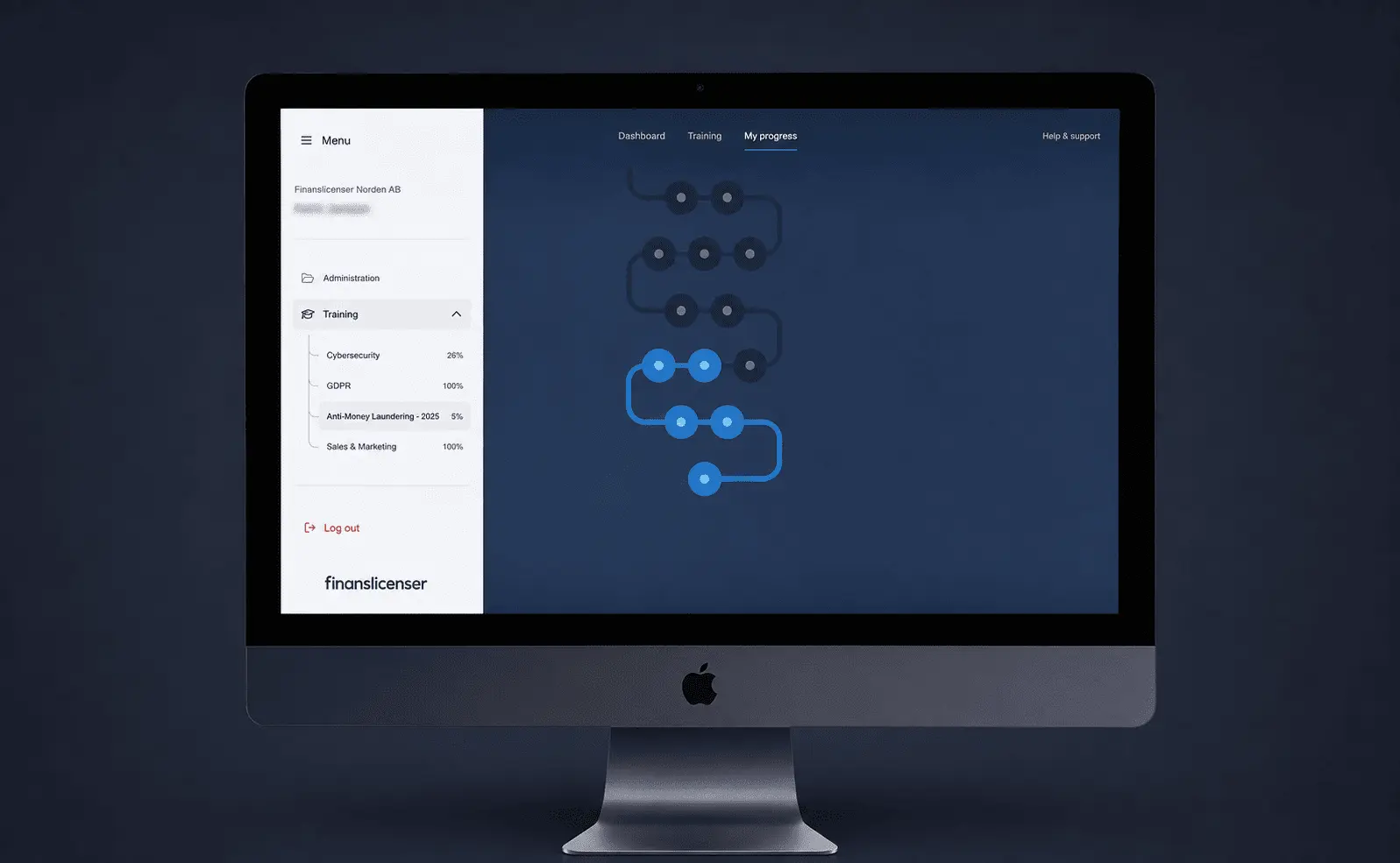
AML training program overview

How It Works

01

Register

Sign up and get instant access via Finanslicenser's website to set up your training dashboard.

02

Learn

Complete the 90-minute digital course or join our interactive sessions at your own pace, custom-tailored to art-trade realities.

03

Certify

Pass the final test and download your valid, audit-ready compliance certificate immediately.

Why Specialist Training Matters

Addressing the Realities of Artwork Commerce

Artwork commerce has distinct risk features that ordinary compliance courses rarely address. Traditional, generic financial courses fail to account for the unique operational patterns of fine art trade transactions, including:

  • • Confidential buyers and high-value private-sale urgency.
  • • Intermediaries, introducers, and multiple agents acting between primary parties.
  • • Complex international logistics, international shipments, and specialized storage arrangements.
  • • Fluctuating threshold calculations, currency conversion issues, and cumulative purchases.
  • • Subjective valuations of major-value objects and collectibles.
  • • Complex corporate ownership structures and sanctions-sensitive counterparties.

We support every type of art market business

Why specialist AML training matters for the art market

Why This Matters for Your Gallery

Your Audit-Ready Shield

The law doesn't expect you to be a detective or to do everything in every situation. It expects you to do the right thing in the right situation—and, most importantly, be able to prove why you made that judgment. When your local Financial Intelligence Unit (FIU) conducts an inspection, they aren't looking for a perfect memory; they are looking for documented competence.

The Finanslicenser Certification

Upon completion of the course, you receive an official AML Certificate that serves as your primary line of defense, delivering:
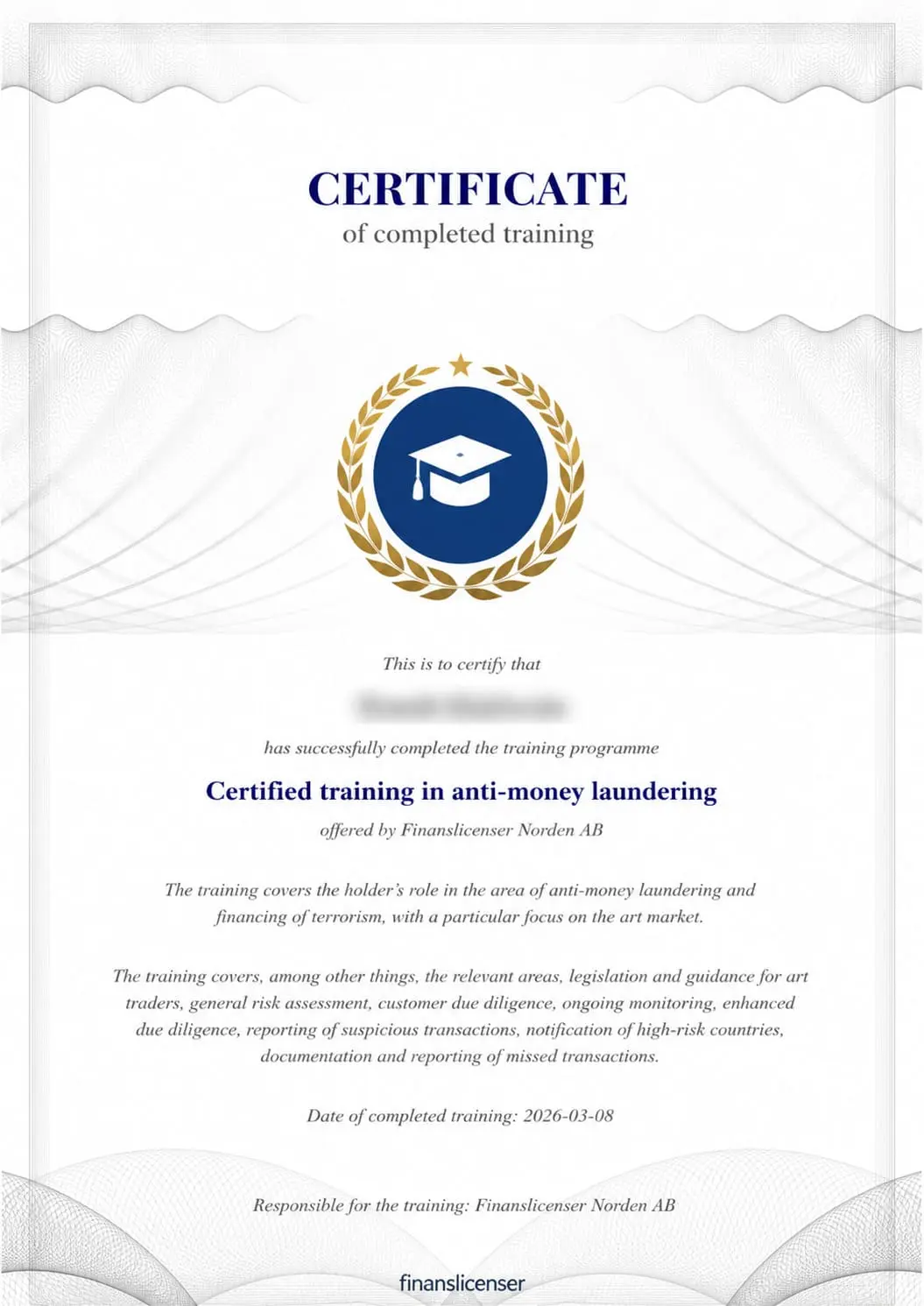
Verified Competence: Instantly prove that you and your staff understand the legal requirements of the Art Market.
Regulatory Alignment: Finanslicenser's curriculum is specifically made to meet the strict standards expected by compliance authorities.
The "Audit-Ready" Folder: Stop scrambling for answers. Having your certificate on hand shows inspectors that your business is proactive, professional, and compliant.

Core Educational Content Pillars

Learners need a clear map of when AML duties apply across commerce involving artworks and collectibles. This includes regulated business status, transaction thresholds, cumulative purchases, exchange-rate movement, fairs, overseas exhibitors, private sales, agents, introducers, intermediaries, artists, advisers, and storage-related activity. The learning goal is to prevent accidental non-compliance caused by assuming the rules apply only to traditional dealers.

Teams must have the skill to verify people and organizations without turning every sale into a legal essay. Training covers individual ID, corporate documentation, beneficial ownership, authority to act, agents acting for buyers, trusts or foundations, remote verification, false documents, and response steps when information is missing or inconsistent.

Every regulated business needs a documented method for judging exposure. This pillar teaches learners to assess client type, artwork category, transaction size, country links, delivery route, payment method, outside-party involvement, and repeat activity. The output is a practical risk model, written procedures, staff responsibilities, review dates, and proof that the framework is used.

Learners learn to recognize patterns that need more scrutiny, including hidden beneficial owners, unusual secrecy, pressure to close quickly, mismatched payer and buyer, sudden changes to invoices, unexplained offshore structures, reluctance to provide ID, requests involving sanctioned regions, inflated or unclear values, and unusual storage or shipping instructions.

Sanctions training has a separate track because the consequences and response steps differ from routine AML checks. Topics include screening, indirect ownership, control by listed parties, luxury-goods restrictions, Russia-related exposure, frozen assets, reporting duties, false positives, escalation, and when a transaction must stop.

Staff learn how concerns move from a conversation or file note to a senior decision. This pillar covers internal reporting, when suspicion may arise, what information to collect, how to avoid alerting the client, when external reporting may be needed, and how long records should be retained.

Prepares businesses for scrutiny by supervisors, banks, insurers, and counterparties. Learners understand how to show registration status, learning records, risk reviews, policy documents, client files, screening outputs, approval notes, exception logs, and remediation steps.

Compliance obligations for dealers, galleries, advisers, and auction teams continue to evolve under UK rules, European Union policy, United States proposals, and international standards. Learners discover methods for tracking guidance updates, national risk reviews, elevated-risk country lists, AML authority developments, corporate transparency rules, and sector-specific consultations without rebuilding procedures from scratch.

Good compliance depends on repeatable workflow. This pillar covers secure evidence collection, remote ID upload, screening records, file notes, reminder cycles, training logs, approval workflows, GDPR-conscious retention, and ways to connect real transaction data to annual policy reviews.

The most useful training helps people sell responsibly, not freeze every deal. Learners are taught how to ask sensitive questions professionally, explain information requests to clients, involve senior staff early, and make proportionate decisions that protect the firm while preserving trust.

Why We Have Chosen Finanslicenser as Our Partner

Proven Pedagogy and Industry Expertise

Finanslicenser combines deep subject-matter expertise with a modern, innovative approach. Their team brings over 15 years of collective experience in finance, regulatory compliance, and pedagogy. By merging industry knowledge with legal expertise and modern technology, they deliver training that is:

Relevant

Content is rapidly updated to reflect new legal requirements and market shifts.

Practical

Focus is placed on methods that are engaging and easy to apply to your daily operations.

Audit-Ready

Ensure your business can act securely and meet the standards of the County Administrative Board.

Flexible Formats & Real-World Practice

Course Formats

Interactive sessions with guided examples, question time, and team discussion — best for organizations that want shared learning and immediate answers to current scenarios.

Self-paced modules for busy teams, new starters, annual renewals, or geographically dispersed staff — best for repeatable training records and flexible completion.

Custom workshops built around your specific operating model, client base, sales channels, risk appetite, and current procedures.

Focused support for policy owners, MLROs, directors, finance teams, and senior approvers dealing with complex files, audits, or regulatory queries.

What Learners Practise

Learners work through highly realistic art-trade examples, including:

  • • A buyer using an adviser and asking to remain unnamed.
  • • A company purchaser with unclear, layered ownership.
  • • A fair sale where payment details change at the last moment when conversations move quickly.
  • • A private transaction linked to an elevated-risk country.
  • • A possible sanctions match requiring careful escalation without tipping off the client.
  • • A bank asking to review your firm's AML controls and training logs.
  • • A client who actively resists identity or funding-background questions.
  • • A staff member unsure whether a concern should become an internal report.

Certification and Evidence

Each course can include attendance tracking, knowledge checks, and completion evidence. Training records should be retained with the business AML file so that supervisors, banks, insurers, or senior stakeholders can clearly see that relevant staff have been effectively trained and refreshed.

The 4-Tier Training Pathway

Format: 2.5 hour live workshop or self-paced digital course with knowledge checks and a completion certificate.

Designed For: New joiners, sales staff, client-facing teams, operations, registrars, finance staff, and owners of small galleries or dealerships.

Purpose: Build a shared team language, master client onboarding, and discover how to keep sales activity moving without ignoring financial-crime exposure.

Core Lessons:

  • •Ways artwork transactions may be misused for laundering, sanctions avoidance, fraud, and concealment of ownership.
  • •Determining exactly when a business, adviser, introducer, or intermediary falls within regulated activity.
  • •Tracking transaction-value triggers, cumulative purchases, currency conversion issues, and suspicious conduct below normal thresholds.
  • •Differentiating between ordinary identity collection, client diligence, enhanced review, and complete refusal/escalation.
  • •Identifying individuals, companies, trusts, agents, representatives, and hidden controllers.
  • •Recording funding and wealth-background questions in a proportionate, professional way.
  • •Spotting common warning signs across private sales, art fairs, international shipments, storage arrangements, and payments from outsiders.
  • •Establishing clear operational rules for when to pause, escalate, decline, or seek senior approval.

Practice Components & Tools: Client intake decision tree, art-fair quick-screening scenario, gallery sale with an agent acting for an undisclosed buyer, company purchaser with layered ownership, payment from a different person than the named buyer, and a post-course checklist for records, policy alignment, and refresher timing.

Format: 75 to 90 minute live update session or short on-demand course with a short assessment and renewed certificate.

Designed For: Trained staff who have already completed foundational training.

Purpose: Renew knowledge, keep procedures current, maintain evidence of ongoing training, and test judgment against updated real-world scenarios.

Core Lessons:

  • •Recent legislative changes affecting UK rules, EU developments, US proposals, and international artwork transactions.
  • •Evolving updates to regulator expectations and sector guidance.
  • •Shifts in sanctions enforcement, asset-freeze notification duties, and restricted-party ownership rules.
  • •New or revised risk indicators for art fairs, intermediaries, storage providers, luxury-goods restrictions, and politically exposed clients.
  • •Reviewing enterprise-level risk reviews and written procedures to satisfy supervisors, banks, or insurers.

Practice Components & Tools: "What changed this year?" compliance briefing, refresher quiz using short transaction examples, review of anonymized weak files versus stronger file notes, and a 30-day compliance action plan for policies, registers, training logs, and client files.

Format: 45 to 60 minute advanced module added after initial training, or a standalone 2-hour leadership clinic.

Designed For: Compliance officers, Money Laundering Reporting Officers (MLROs), responsible senior managers, founders, directors, finance leads, and senior file approvers.

Purpose: Build the strategic decision-making discipline needed to own firm controls, supervise teams, manage high-risk escalations, and respond confidently to audits.

Core Lessons:

  • •Governance roles: tracking who owns policy, who approves risk, who trains the team, and who signs off exceptions.
  • •Building an enterprise risk review that reflects actual clients, channels, products, geography, and transaction patterns.
  • •Designing written AML procedures that staff can actually follow in real-world environments.
  • •Executing enhanced review (EDD) for complex ownership, major transactions, elevated-risk countries, PEP exposure, and sanctions proximity.
  • •Using third-party reliance safely when another regulated party has performed checks.
  • •SAR decision-making: suspicion thresholds, internal escalation, consent issues, and records.
  • •Responding to bank audits, regulator visits, supervisory questions, and remediation requests.

Practice Components & Tools: Senior approval memo exercise, SAR triage simulation, sanctions ownership puzzle using indirect control models, regulator visit preparation checklist, and a policy gap review using a mock client file set.

Format: 60 to 120 minute interactive rehearsal workshops available as individual sessions for mixed teams or role-specific groups.

Workshop A: Fair and Pop-Up Sales Controls

  • •Preparing compliance checks before doors open.
  • •Identifying the buyer when conversations move quickly on the floor.
  • •Handling agents, advisers, and last-minute payment changes off-site.
  • •Documenting compliance checks when staff are off-site.

Workshop B: Private Sales, Advisers, and Intermediaries

  • •Deciding exactly which party belongs in the primary client role.
  • •Separating introductions, legal representation, and true transaction control.
  • •Managing client confidentiality requests without losing audit evidence.
  • •Spotting unusual urgency, opacity, or inconsistent client explanations.

Workshop C: Sanctions and Ownership Screening

  • •Screening names, entities, directors, beneficial owners, vessels, storage locations, and connected parties.
  • •Understanding indirect ownership and complex control exposure.
  • •Reacting to a possible sanctions match without alerting the client (tipping off).
  • •Recording a clear no-match, false positive, or confirmed concern.

Workshop D: Policy, Risk Review, and Evidence File Sprint

  • •Translating law and guidance into a workable corporate policy.
  • •Aligning your risk review with real sales channels and client types.
  • •Retaining documentation safely during the mandatory period.
  • •Proving training records, approvals, exceptions, and ongoing monitoring to auditors.

Workshop E: Suspicion, Reporting, and Defensive File Notes

  • •Structuring internal routes for staff concerns.
  • •Formulating senior decisions on external escalation.
  • •Writing objective, defensive file notes that separate facts, assumptions, and decisions.
  • •Preserving confidentiality while meeting statutory reporting duties.

Ready to Get Certified?

Join galleries, dealers, and auction houses who have completed their AML certification through Finanslicenser. It takes 90 minutes. The protection lasts indefinitely.

5-step AML Compliance Guide cover

Download your 5-step guide to AML Compliance

A clear, practical guide to the five key steps any art business needs to take to meet EU anti-money laundering requirements and build lasting client trust.