A Practical AML Compliance Guide for Art Market Businesses Selling Across Europe
France, Germany, and Italy
Emil Björck
Founder & AML Specialist · Reviewed by the KYCProtect Compliance Team
Compare AML expectations for art businesses operating across France, Germany, and Italy, including LCB-FT, GwG, Antiriciclaggio, and what the EU Single Rulebook means for cross-border compliance.
Selling art across Europe sounds commercially attractive until the compliance reality arrives. A gallery may market to collectors across the region, work with advisors and agents in multiple jurisdictions, and invoice buyers through different corporate arrangements. Yet once anti-money laundering obligations enter the picture, those cross-border ambitions often run straight into local complexity.
France, Germany, and Italy are especially important because they combine major art market relevance with distinct compliance language and supervisory cultures. Businesses may hear references to LCB-FT in France, GwG in Germany, and Antiriciclaggio in Italy, while also trying to understand what the EU Single Rulebook will change over time. The result is a common problem: firms know the broad European direction, but they struggle to operationalise that knowledge when a real buyer or entity appears from a particular member state.
This article explains why those differences matter, where the biggest implementation pain points appear, and how art businesses should respond if they want a process that works across all three markets.
Why Member-State Friction Still Matters
Although the EU is moving toward stronger harmonisation, local language, reporting culture, registry access, and practical expectations still shape how compliance work gets done. That means art businesses cannot rely on a purely abstract “EU compliance” model. They need to know how member-state variation affects day-to-day diligence.
For example, a French corporate buyer may be approached with assumptions based on local commercial familiarity. A German entity may feel more transparent because of the market’s formal reputation. An Italian structure may be treated as more complex because of language or registry access challenges. These instincts can be misleading. Good compliance does not come from assumptions about national reputation. It comes from a consistent process that can handle each jurisdiction confidently.
France: LCB-FT and Practical Considerations
In France, references to LCB-FT reflect the broader anti-money laundering and counter-terrorist financing framework. For art businesses, the practical issue is not just the terminology. It is understanding how French counterparties, structures, and documentation interact with the wider AML process.
French buyers may act through companies, holding vehicles, or advisors. Corporate onboarding may appear simple at first glance, but beneficial ownership, management control, and payment logic still require structured review. Businesses also need to be prepared to understand the relevance of French reporting and supervisory references where appropriate.
The main operational lesson with France is that familiarity should not weaken discipline. If the business treats French clients as automatically low friction simply because the market is well known, it risks under-documenting ownership and transaction logic.
Germany: GwG and Control Discipline
Germany often carries a reputation for order and formality, which can lead firms to assume the compliance file will be easier. In some cases, that may be true. But German entities can still present layered structures, complex beneficial ownership questions, and cross-border commercial links that need careful analysis.
The practical value of understanding the GwG context is that it reminds businesses not to confuse documentation with certainty. A file may look structured and still require more scrutiny. If a German buyer sits inside a broader ownership chain or uses a cross-border payment route, the review should not end with the first company extract.
For art businesses, the key is to apply the same discipline to German clients as to any other cross-border entity. The jurisdiction may be familiar, but the structure may not be.
Italy: Antiriciclaggio and the Cross-Border Verification Challenge
Italy often creates the strongest practical friction for art businesses not because of inherent higher risk in every case, but because firms feel less confident in handling local company forms, registry interpretation, and ownership review.
That makes Italy a particularly strong area for KYC Protect differentiation. Businesses want to know how to verify an Italian S.r.l. or other entity type in a way that is both fast and defensible. They do not want abstract theory. They want a process.
The compliance lesson is clear: if the firm handles Italian entities regularly, it should not leave review quality to staff improvisation. It should define exactly what evidence is collected, how ownership is interpreted, when escalation applies, and what documentation standard must be met.
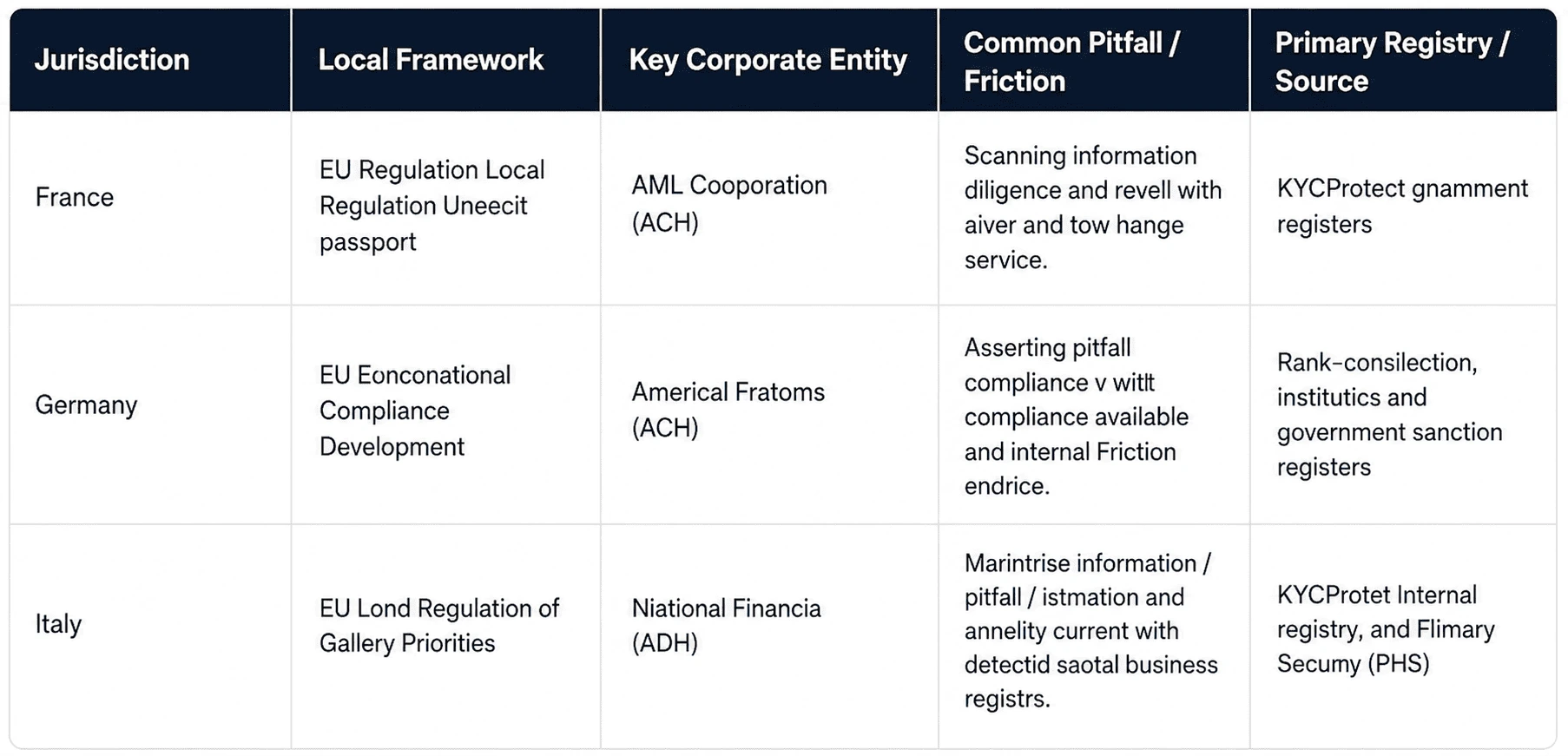
Comparison matrix table comparing AML compliance frameworks, corporate entities, common pitfalls, and primary registries across France, Germany, and Italy.
The Common Problem Across All Three Markets
The common problem is not that France, Germany, and Italy are impossible to handle. It is that many art businesses approach them with fragmented logic.
One team may be comfortable with France and cautious with Italy.
Another may treat Germany as low friction and skip deeper ownership analysis.
Another may rely too heavily on local relationship comfort rather than consistent rules.
This is how cross-border inconsistency develops. The business says it applies a risk-based approach, but in practice it applies a confidence-based approach, where staff scrutiny rises or falls depending on how familiar they feel.
That is not sustainable under a more harmonised AML environment.
What a Better Cross-Border Model Looks Like
A better model begins with shared minimum standards across all three jurisdictions. The business should define what identity evidence is needed, how legal entities are verified, when beneficial ownership review is required, and what events trigger escalation. Local law and language still matter, but the core diligence standard should remain coherent.
The second step is member-state guidance. Staff should have practical playbooks for French, German, and Italian clients so they understand what local terms, structures, and evidence sources are relevant.
The third step is documentation. Files should clearly show not only what was collected, but how the business reached its conclusion.
The fourth step is review and training. If one jurisdiction repeatedly creates delay or uncertainty, that should feed into updated guidance and workflow support.
How Firms Should Organise Internal Guidance
A practical approach is to create one shared EU-wide baseline and then layer member-state guidance on top. The baseline should define what the business always does: identity verification, entity review, ownership analysis, sanctions screening, and escalation. The member-state layer should help staff interpret local company forms, terminology, registry expectations, and common friction points.
This prevents the business from treating each country like a separate AML world while still giving teams enough local context to act confidently.
Where Most Friction Appears
In France, firms often struggle with how local terminology connects to wider internal process.
In Germany, they may underestimate complexity because the file appears orderly.
In Italy, they often lose time because staff are less confident interpreting the structure quickly.
None of those issues are unsolvable. They simply show why cross-border readiness needs structure.