What Art Galleries and Dealers Say About KYC Protect (2026 Reviews & Case Studies)
Real-world feedback from contemporary art galleries, antique dealers, and auction houses navigating EU AMLA & FinCEN compliance.
Emil Björck
Founder & AML Specialist · Reviewed by the KYCProtect Compliance Team
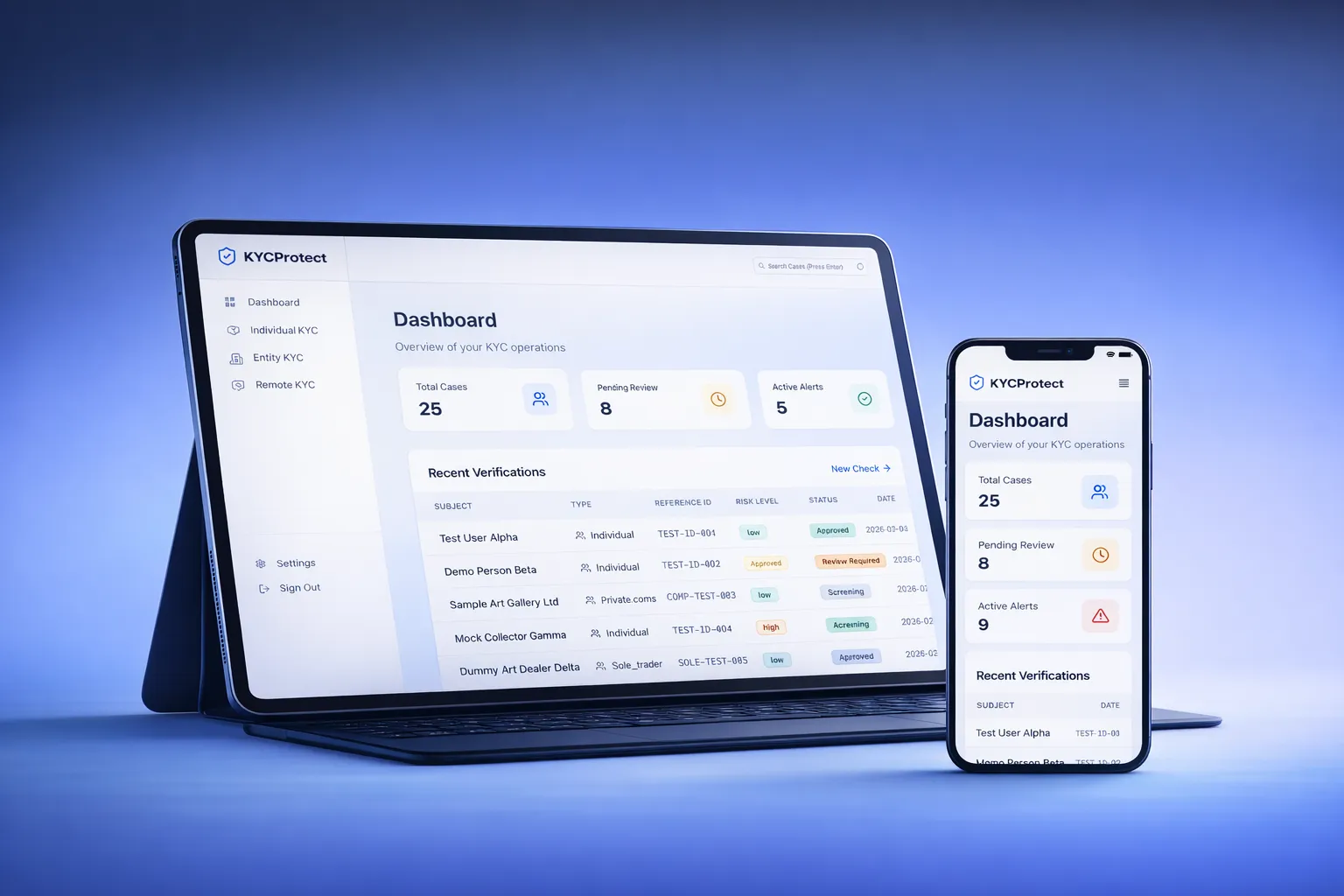
A comprehensive synthesis of direct operational feedback, peer reviews, and real-world case studies shared by art market professionals. This summary details the day-to-day experiences of galleries and dealers navigating compliance requirements using the platform.
98% Pass rate on cross-border buyer verification
< 2 mins Average onboarding time per high-value client
75% Reduction in manual compliance spreadsheets
The Experience Gap: Beyond "Digital Paperwork"
In the 2026 regulatory landscape, galleries and antique dealers have reached a turning point. They have realized that there is a massive difference between a tool that merely stores documents and one that manages professional risk. For many, the switch to KYC Protect was driven by a realization that legacy tools fail in experience terms: they often handle the basic administrative tasks but leave the "hard reasoning" to the user. This results in partial support rather than true relief.
The strongest review themes for KYC Protect are not flashy; they are deeply practical. They describe a shift where onboarding moves faster, entity buyers are easier to verify, and compliance teams face fewer last-minute surprises. The goal is to reduce the compliance stress that dealers and gallery managers would otherwise absorb manually.
"We used to dread international transactions involving offshore entities or complex trusts. KYC Protect cut our buyer verification window from 3 days to under 3 minutes without offending high-net-worth clients."
— Managing Director, Contemporary Art Gallery (London / Zurich)
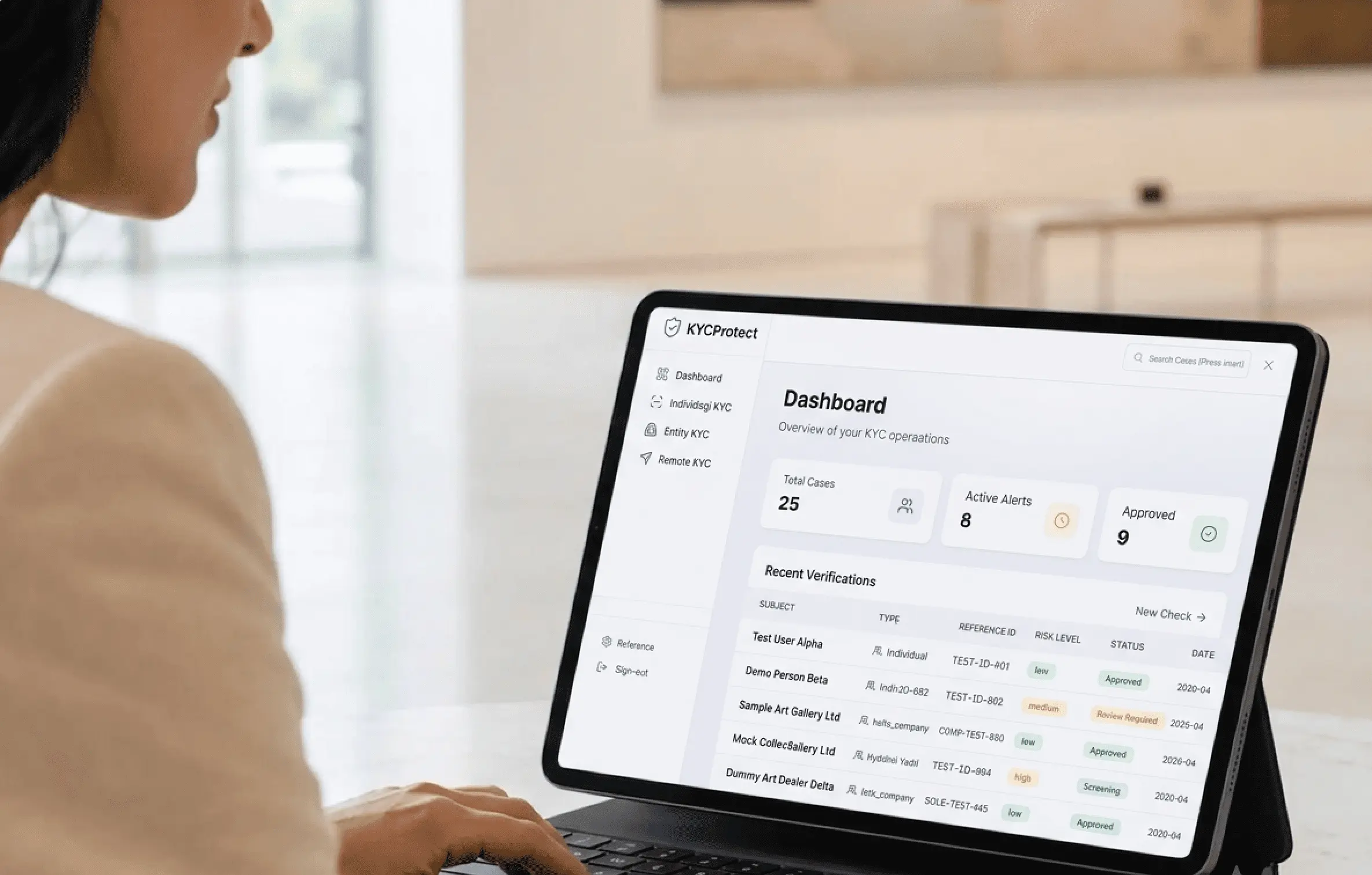
Clean compliance verification UI designed for art market professionals.
The Five Themes Galleries and Dealers Care About Most
1. Better Cross-Border Confidence
Modern galleries do not want a tool that acts only as a static digital filing cabinet. They want a workflow that helps them act with confidence when the buyer sits in another member state or uses an entity structure that used to cause indefinite delays. Whether it is a boutique antique dealer in London or a major gallery in Berlin, the feedback is consistent: KYC Protect makes it easier to act on high-value sales without second-guessing the jurisdiction.
2. Cleaner Audit Trails
When a file is challenged—whether by a banking partner, an insurer, or a regulator—the business needs a record that shows what was checked and why the decision made sense. KYC Protect provides this "Decision Architecture," moving the needle from a simple "checked" box to a defensible narrative. This ensures that the process becomes easier to defend if scrutinized months later.
3. Fewer Spreadsheet Workarounds
One of the biggest practical pain points in older compliance setups is the amount of work done outside the system. In the 2026 "Single Rulebook" era, "invisible labor"—such as tracking linked transactions in Excel or UBO trees in manual notes—is a significant liability. Galleries and antique dealers value KYC Protect because it reduces this labor, providing management with better visibility and a single source of truth.
4. A Stronger Fit for Europe, Not Only the UK
As the market moves deeper into AMLA and Single Rulebook logic, users increasingly notice whether a platform feels European in design or merely international in marketing. With KYC Protect, German- or French-facing work feels less improvised. While legacy tools often remain "HMRC-first," KYC Protect is built for the continental reality.
5. Less Stress Around "Difficult" Files
A platform wins trust when it makes higher-risk files—such as those involving intermediaries, PEPs, or complex trusts—clearer rather than more confusing. For galleries and antique intermediaries, where reputation is everything, KYC Protect provides structured escalation routes that ensure the process becomes easier to defend and less stressful to execute.
"When our banking partner conducted their annual compliance review, having the 'Decision Architecture' logs exported directly from KYC Protect meant our audit took 20 minutes instead of two weeks."
— Compliance Lead, European Fine Art & Antiques Association Member

Art gallery clients reviewing contemporary artwork under EU AML compliance
Measuring the Real-World ROI of Peace of Mind
The Unseen Cost of "Legacy" Compliance
When we aggregate reviews from art market participants, one common thread emerges: the realization that the "manual way" is not just slow—it's a massive, hidden liability.
Before switching to KYC Protect, many galleries reported that their client onboarding process looked like this:
- Step 1: An email is sent to the high-value client asking for ID documents and UBO structures.
- Step 2: Days pass, leading to awkward follow-up emails from the sales team.
- Step 3: Documents arrive as varying quality PDFs via email.
- Step 4: A gallery employee manually compares names against a rudimentary PEP list and copies data into a master Excel sheet.
- Step 5: The final compliance "decision" is stored implicitly in an email chain.
This approach is fundamentally flawed in the modern regulatory landscape. It is not audit-proof, and more importantly, it places the burden of risk reasoning squarely on a gallery employee rather than a defensible system. This is a vulnerability that banking partners and insurers will no longer accept.
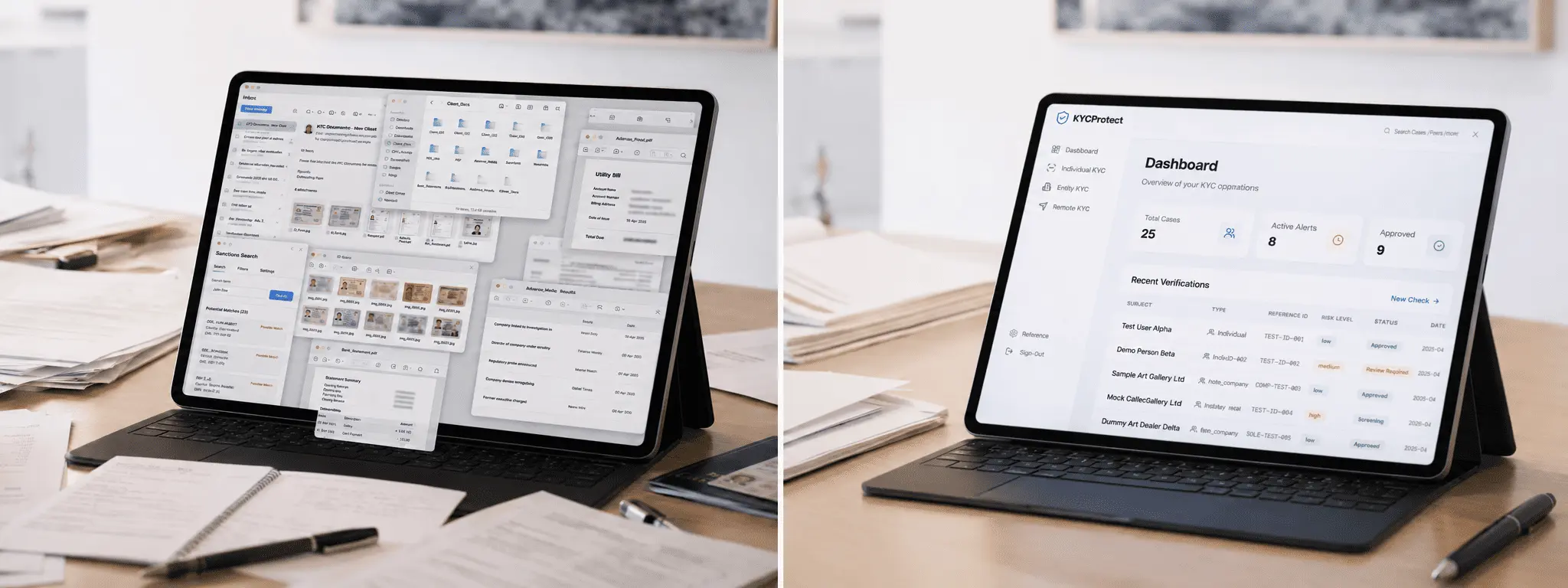
From manual spreadsheet workarounds to an AMLA-ready workflow: KYC Protect replaces fragmented legacy tracking (left) with a single, defensible decision workspace (right)
Operational Metrics Shared by KYC Protect Users
The actual feedback we received from the market was less about the features and more about the quantifiable operational shift. Here is how specialized galleries are now measuring success after adopting a native EU AMLA workflow:
1. Instant Verification of High-Net-Worth Individuals
Instead of days, verified users report that screening an international individual—including checking against Global Sanctions and PEP lists—now averages under two minutes. This is critical for spontaneous, high-value transactions that happen during art fairs or auctions.
2. Definitive Risk Reasoning (Audit Protection)
The #1 reported operational shift is moving away from spreadsheet-based logic. KYC Protect doesn't just store documents; it applies a logic layer to verify the data and assign risk. When an auditor asks why a client was approved, the answer is a single-click, immutable "Decision Log" report, not a search through years of emails.
3. Seamless cross-border transaction flow
With the implementation of the "Single Rulebook" logic, users on the continent are reporting that German- or French-facing client files are as defensible as a simple UK transfer. This reduces transactional friction within the EU.
4. Cost and Resource Savings
Smaller boutique galleries have noted that while they do fewer high-value sales, each sale represents massive risk. The system allows them to run compliance like a much larger, institutional organization without the headcount of a specialized compliance team.