Art Market AML: Compliance for Galleries, Dealers and Auction Houses
Art businesses handling qualifying high-value transactions may need to verify clients, identify beneficial owners, screen for sanctions and PEPs, assess transaction risk and keep evidence of the checks they perform. This guide explains when AML rules apply, what art businesses actually need to do, and how to build a practical compliance process.
Does AML apply to your art business?
Anti-Money Laundering (AML) rules require businesses to identify who they are doing business with, understand the purpose and risk of the transaction, keep records and report suspicious activity when required. For the art world, these rules usually apply when an art business sells, buys, stores or acts as an intermediary in high-value works of art. In the EU and UK, the key threshold is generally EUR 10,000 for one transaction or several linked transactions.
European Union
AML requirements generally apply to persons trading in or acting as intermediaries in works of art where a transaction, or a series of linked transactions, reaches at least EUR 10,000.
United Kingdom
Art Market Participants carrying out qualifying transactions of EUR 10,000 or more fall within the UK AML framework.

For the art world, AML rules often apply if you:
If this describes your business, the next question is what you actually need to have in place.
Why Art AML Compliance Matters Now
Across Europe and the UK, what was once a private, relationship-based business has evolved into a strictly regulated sector. For galleries, auction houses, and independent dealers, this means you are now legally responsible for verifying your clients, understanding who ultimately owns or controls companies and trusts, monitoring high-value transactions, and keeping a clear record of the decisions your team made.
Art is attractive to criminals because it can move large value discreetly, cross borders easily, and involve agents, companies, trusts, offshore structures or third-party payers that hide the real buyer or seller. AML compliance is not just about avoiding fines. It protects your reputation, your banking relationships, your collectors, your artists and your ability to complete sales with confidence.
What Do You Actually Have To Do?
A structured AML programme generally rests on six responsibilities. Each one is explained in more detail below.
- Verify the client — confirm who your buyer, seller or relevant intermediary actually is.
- Identify beneficial ownership — for companies, trusts or other entities, establish who ultimately owns or controls them.
- Screen the client — check relevant sanctions, PEP and adverse-media information.
- Assess the transaction — consider client profile, value, geography, payment route, ownership structure, provenance and other relevant risk factors.
- Carry out enhanced checks where necessary — including source of funds or source of wealth where the circumstances require deeper review.
- Keep evidence — store documents, checks, risk assessments and decisions in a way that can be reviewed later.
In practice, this means:
- Check IDs: Verify the identity of your buyers, sellers and relevant intermediaries.
- Understand beneficial ownership: Identify the real person who owns or controls a company, trust or other structure.
- Screen for sanctions: Ensure your client is not on a global do-not-trade list.
- Check PEP status: Identify whether the client or beneficial owner is politically exposed or connected to someone who is.
- Check for bad press: Look for credible media that links a client to fraud, corruption, sanctions evasion, financial crime or other serious concerns.
- Keep records: Store your checks, documents and decisions safely for at least five years where applicable, so you remain audit-ready.
- Escalate suspicion: If something cannot be explained, escalate internally and consider whether a Suspicious Activity Report is required.
Manage the AML workflow in one place
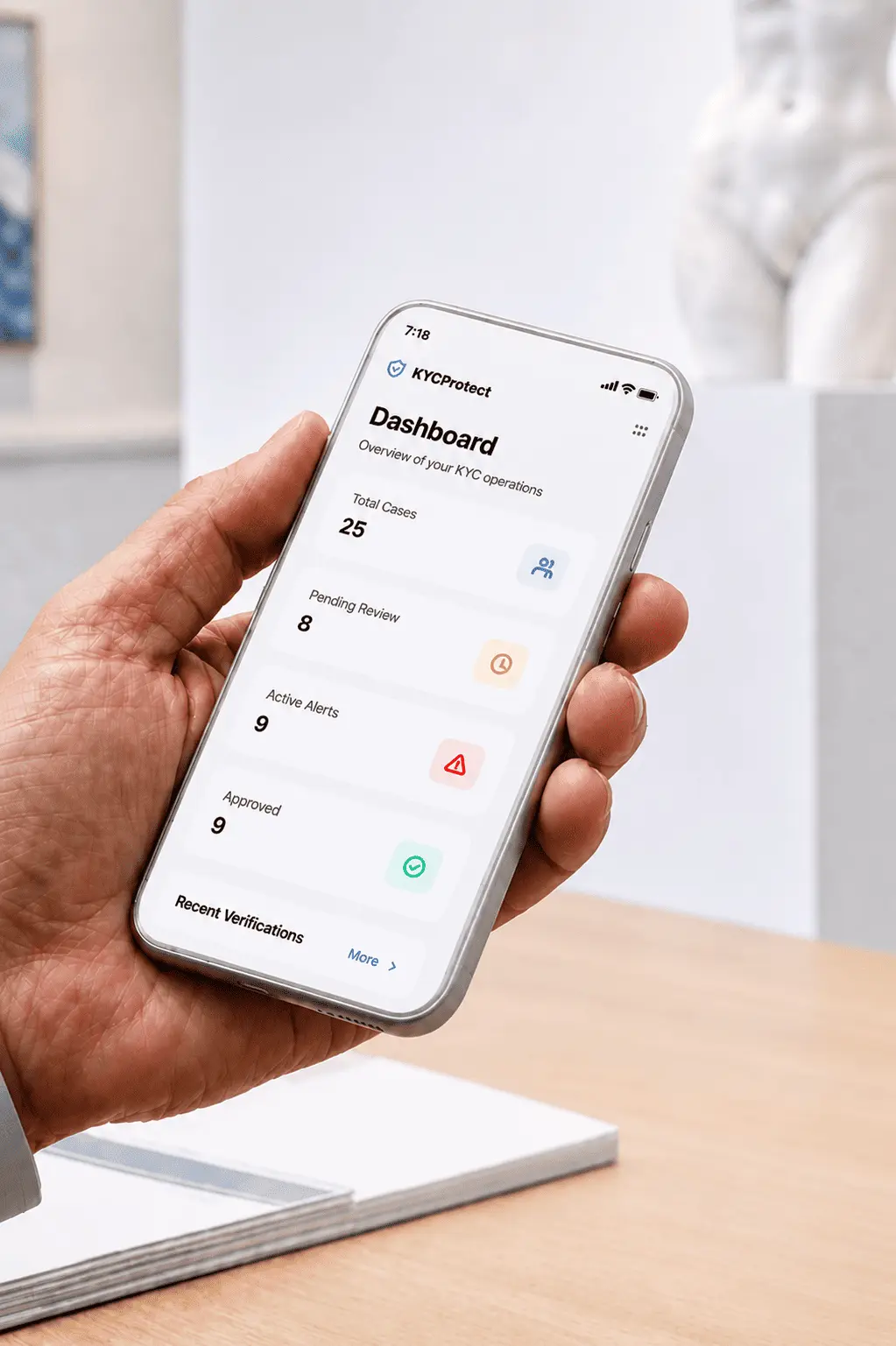
KYCProtect gives galleries, dealers and auction businesses one place to collect client information, run screening checks, assess transaction risk and keep the evidence behind each decision.
Instead of managing separate spreadsheets, emails, ID folders and screening records, each client and transaction can follow a structured compliance process.
- Client verification: Collect and verify client and beneficial-owner information.
- Sanctions and PEP screening: Run and record relevant screening checks.
- Risk assessment: Document client and transaction risk consistently.
- Audit-ready records: Keep documents, screening results and decisions together.
- Branded experience: Put your brand front and center with a verification process that looks and feels like it comes directly from you.
Built around how art transactions actually work
Generic KYC tools often assume a standard financial onboarding flow. Art market compliance is different. A single transaction may involve a buyer, payer, intermediary, advisor, shipping destination, corporate vehicle, beneficial owner and artwork-specific context.
KYCProtect is built around the realities of high-value art transactions, including:
- Individual collectors and repeat collectors
- Companies, trusts and beneficial owners
- Agents, advisers and intermediaries
- Third-party and international payments
- High-value and cross-border transactions
- Source-of-funds and source-of-wealth checks

Manual AML processes vs a structured workflow
Many galleries still use paper files, PDF checklists, basic spreadsheets or scanned IDs sent over email. While this might seem easy, it can leave you exposed to missing evidence, inconsistent decisions, privacy problems and regulatory scrutiny.
| Feature | Manual Process | KYCProtect Workflow |
|---|---|---|
| Updates | You have to check lists yourself. | Alerts help flag sanctions or risk changes. |
| Safety | Client documents can become spread across inboxes, folders and individual staff records. | Client files are stored in a structured, controlled workflow. |
| Audits | Preparing evidence for an internal review or audit can require searching across multiple records. | Documents, checks, decisions and timestamps are ready for review. |
| Mistakes | Higher risk of human error and inconsistent team decisions. | Guided workflows help every team member follow the same process. |
| Client experience | Repeated document requests can feel messy and unprofessional. | A clean verification process protects trust and reduces friction. |
A professional process for you and your clients
Before trusting a system with client information, gallery directors rightly ask how that information is handled. KYCProtect is designed so that sensitive compliance records stay within a controlled workflow rather than moving through inboxes and shared folders.
Structured client records
Identity, ownership, screening and risk information kept together in one case file instead of scattered across emails.
Encrypted in transit and at rest
Data is protected using industry-standard encryption while moving between users and the platform, and while stored.
EU/EEA data residency
Primary client data is hosted within the European Economic Area, with appropriate safeguards for any transfers.
Role-based access
Commercial teams can see whether a client is cleared without unnecessary access to passports or source-of-funds evidence.
Immutable audit trail
Key actions, checks and decisions are recorded so your file can support internal review, bank queries or supervisory checks.
GDPR-aligned processing
KYCProtect operates under a data processor agreement and does not sell client or collector data.
For more detail, see our Trust & Security and Privacy Policy pages.
Is your current AML process ready?
A gallery, auction house or art dealer should generally be able to demonstrate the following as part of a structured AML programme:
Art market AML regulations in more detail
| Region | Who is in scope | Key trigger | Core expectations | Current position |
|---|---|---|---|---|
| European Union | Persons trading or acting as intermediaries in cultural goods, including galleries and auction houses. | Transactions or linked transactions of at least EUR 10,000. | Customer due diligence, beneficial ownership checks, risk-based monitoring, suspicious reporting and record keeping. | AMLD5 brought art actors into scope. The 2024 AML package includes Directive 2024/1640, Regulation 2024/1624 and the new AMLA authority. |
| United Kingdom | Art market participants and Freeport operators supervised by HMRC. | Trading in, acting as an intermediary in, or storing works of art worth GBP 10,000 or more. | HMRC registration, written risk assessment, CDD, ongoing monitoring, SAR escalation, staff controls and record keeping. | HMRC guidance applies to AMPs under the Money Laundering Regulations. |
| United States | Financial institutions under the BSA, with FinCEN rulemaking focused on antiquities dealers; high-value art remains a monitored risk area. | Pending antiquities rules, sanctions exposure, bank scrutiny and cash payments above USD 10,000. | Risk-based checks, sanctions awareness, cash reporting where applicable and readiness for evolving FinCEN expectations. | There is not yet a blanket BSA AML program rule for all high-value art dealers, but FinCEN has issued art and antiquities guidance and an antiquities ANPRM. |
5AMLD, the 2024 EU AML Package and UK AML Regulations
The Fifth Anti-Money Laundering Directive (5AMLD) was a watershed moment for the global art market. Implemented across EU member states from January 2020, it brought art dealers, galleries, auction houses and art advisors into the AML framework when they trade in, or act as intermediaries in, qualifying high-value art transactions.
The practical implication is significant. For any transaction, or series of related transactions, reaching EUR 10,000 or more, art market participants must perform customer due diligence. This means verifying the identity of relevant parties, screening against sanctions and PEP databases, assessing transaction risk and storing documentation in a way that can be reviewed later.
The EU AML package adopted in 2024 goes further by creating a more harmonised EU framework. Regulation 2024/1624 sets out directly applicable AML requirements, Directive 2024/1640 updates national supervisory frameworks, and the Anti-Money Laundering Authority (AMLA) is designed to improve consistent supervision across the EU.
In the United Kingdom, equivalent requirements are set out in the Money Laundering, Terrorist Financing and Transfer of Funds (Information on the Payer) Regulations 2017, as amended. HMRC supervises art market participants and expects businesses to maintain a written risk assessment, apply customer due diligence, monitor transactions, train staff, report suspicion and keep records.
Enhanced Due Diligence (EDD) is required in higher-risk situations, such as dealings involving Politically Exposed Persons, high-risk jurisdictions, complex corporate structures, unusual payment routes or unexplained third-party payments.
Suspicious Activity Reports (SARs) must be considered whenever a regulated business knows or suspects that a client is engaged in money laundering or terrorist financing.
KYCProtect was built to close this gap. The platform supports the full compliance workflow from initial CDD through to EDD, ongoing monitoring and audit reporting in a system designed specifically for the art market.
Step-by-Step Compliance Workflow
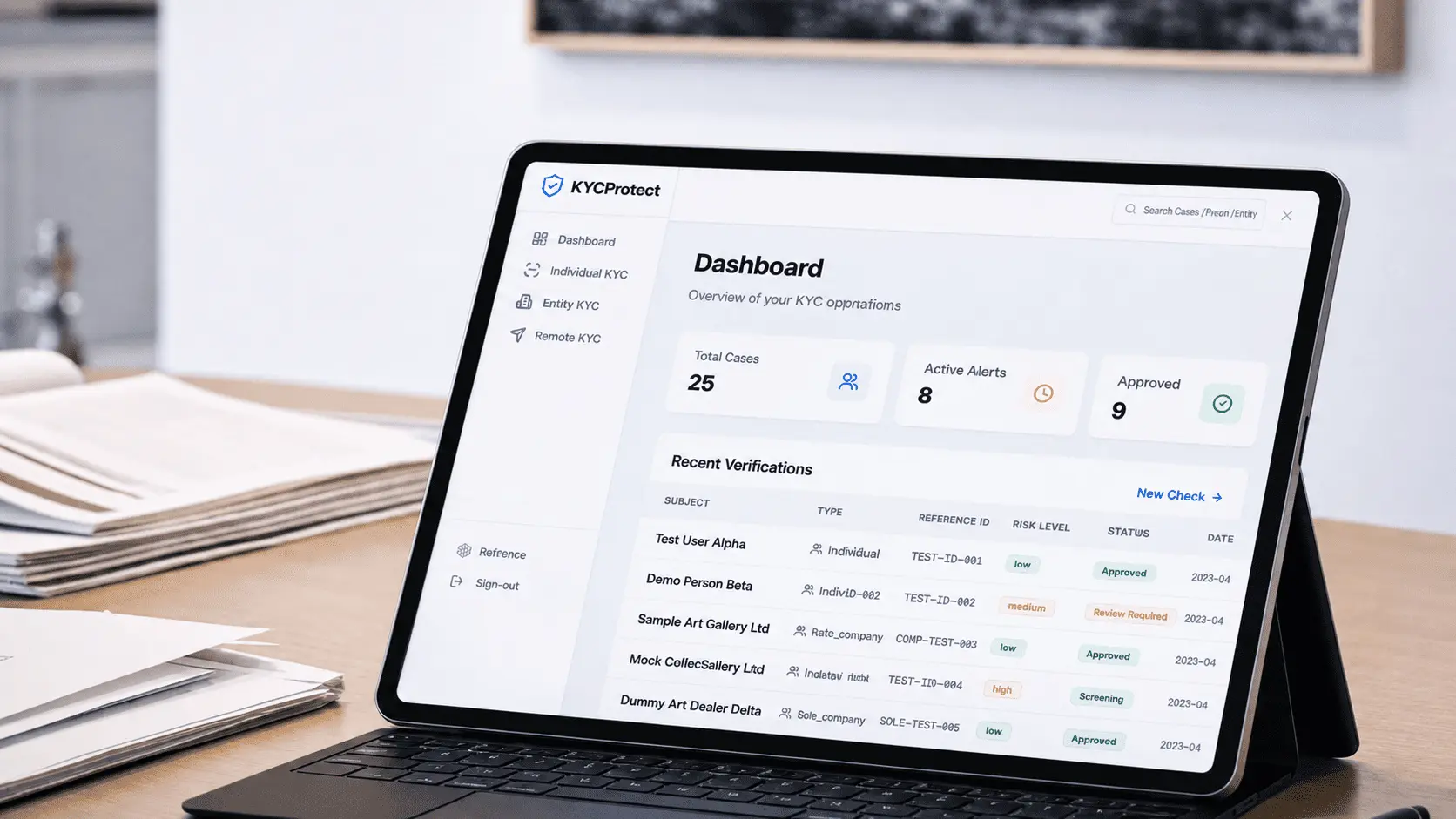
Use this simplified roadmap for KYC for art dealers, AML for galleries and auction house AML compliance.
Onboarding
Collect identity details for buyers, sellers and relevant intermediaries. For individuals, verify name, date of birth, address and ID. For companies, identify the entity, directors or controllers and beneficial owners.
Screening
Check the client, beneficial owners and relevant intermediaries against sanctions, PEP and adverse media sources.
Risk Assessment
Rate the client and transaction as low, standard or high risk. Higher risk should trigger enhanced due diligence, meaning deeper checks on identity, source of funds, source of wealth, ownership and transaction purpose.
Ongoing Monitoring
For repeat collectors, advisors or dealers, refresh records when circumstances change, ID expires, new risk appears or a new high-value transaction is proposed.
Escalation and SAR Decision
If something cannot be explained, escalate internally to the MLRO or responsible compliance lead. If there is knowledge or suspicion of money laundering, consider whether a Suspicious Activity Report is required.
Record Keeping
Keep a clear audit trail: identity evidence, screening results, risk rating, ownership checks, source of funds evidence, internal decisions and transaction documents.
AML Training Specifically for the Art Market
Knowing the rules is just as important as having the right tools. That is why KYCProtect can sit alongside specialist AML training for art dealers, galleries and auction houses. Unlike generic compliance courses, art market AML training should address the real scenarios your team faces every day: handling agents, installment payments, private sales, beneficial ownership, source of funds checks, high-value international transactions and red flags that appear during client onboarding.
Audit-ready in 90 minutes.
Complete the course at your own pace and receive a practical, step-by-step framework your team can apply immediately.
AML Glossary for Art Businesses
Frequently Asked Questions
Download your 5-step guide to AML Compliance
A clear, practical guide to the five key steps any art business needs to take to meet EU and UK anti-money laundering expectations and build lasting client trust.
Regulatory Sources
- EU Regulation 2024/1624
- EU Directive 2024/1640
- HMRC guidance for art market participants
- HMRC art market risk guidance
- FinCEN antiquities and art notice
This page is general information for art businesses and is not legal advice. Requirements vary by jurisdiction, business model and transaction facts.